Materials
FRP vs PP vs Stainless Steel Scrubber: Which Material Survives Your Gas?
FRP vs PP vs stainless steel scrubber: which material survives your gas? Compare corrosion resistance, HF, wet HCl, weight and cost — with a decision guide.
FRP vs PP vs Stainless Steel Scrubber: Which Material Survives Your Gas?
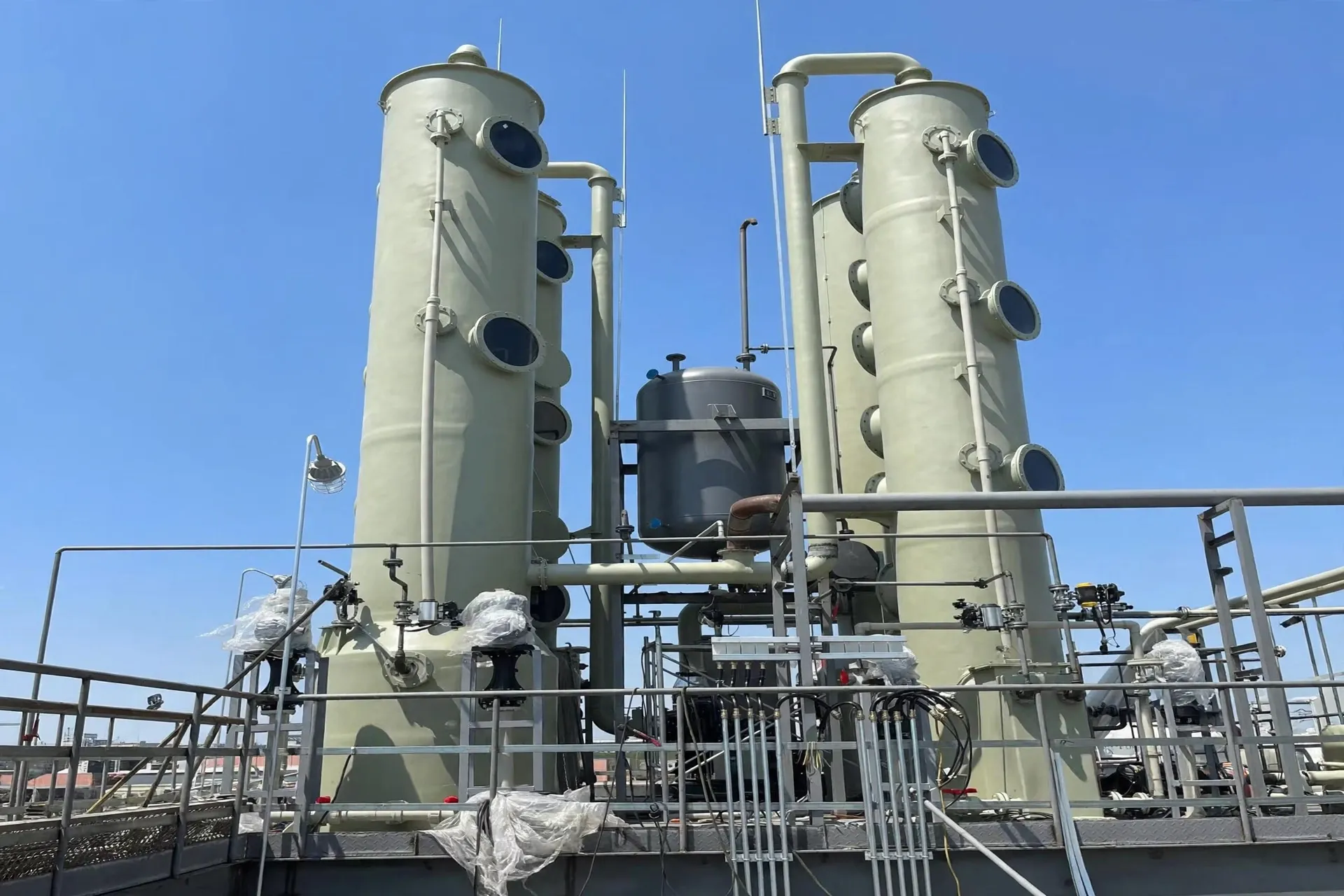
Direct answer: For most wet acid-gas scrubbing, FRP is the default because it resists acids and alkalis, is light, and can be built to any size — but only with the right resin and the right production process. Even hydrofluoric acid (HF), which attacks glass fibre, can be handled in FRP when the production process is adjusted for it; PP is the alternative when that adjustment is not offered. Stainless steel is strong and stiff, but it is the wrong choice for wet hydrogen chloride (HCl), which causes pitting and chloride stress-corrosion cracking. The gas, its concentration and its temperature decide the material — not the catalogue price.
Who This Guide Is For
This article is written for EPC contractors and environmental equipment integrators who have to specify a scrubber tower before ordering one, and for distributors who need to check whether a supplier's proposal fits the project. If you have already been quoted a tower, the table below tells you which questions to ask before you accept the material.
The Problem: The Wrong Material Fails From the Inside
A scrubber tower looks simple from the outside — a vessel, a spray system, a fan. The failure almost never starts on the outside. It starts where the gas and the scrubbing liquid touch the wall, day after day:
- An acid that the wall cannot resist thins it, cracks it, or eats through it — sometimes in months, while the tower still looks fine from the outside.
- A material that is strong when new can become brittle or perforated where liquid collects, at welds, joints and the bottom recirculation tank.
- A tower that survives the gas but not the temperature warps, softens or loses strength when the gas runs hotter than the design.
That is why "which material?" is not a preference question. It is the first engineering decision, and it has to be answered from the gas itself: what it is, how concentrated it is, and how hot it is. A supplier who quotes a material without asking those three facts is guessing.
The Three Materials, Compared
| FRP (fibreglass-reinforced plastic) | PP (polypropylene) | Stainless steel |
|---|---|---|---|
What it resists well (general guidance) | Most acids and alkalis, including HCl, SO₂, NH₃ and H₂S, when the resin is correctly chosen; HF too, when the production process is adjusted for it | Most acids and alkalis, including HF; no glass fibre to attack | Dry gases, high temperatures, mechanical wear; strong and stiff |
Where it is weak (general guidance) | HF attacks the glass fibre, so HF service needs the production process adjusted for it — resin system, corrosion barrier and curing set for HF duty; ask how it is built. Wrong resin choice is the most common failure | Lower stiffness and lower temperature ceiling than FRP or steel, so large towers need more support and careful design; confirm the temperature limit for your gas | Wet HCl causes pitting, crevice corrosion and chloride stress-corrosion cracking; not a safe default for wet acid-gas scrubbing |
Weight and handling | Light; large diameters are practical and transport is easier | Light; welded construction | Heavy; needs stronger foundations and lifting |
Cost picture (relative, no prices) | Usually the economical choice for a custom corrosive-gas tower; cost is driven by size, resin grade and packing, not by the material alone | Often economical for smaller towers and ductwork; cost rises with the support structure on large sizes | Usually the most expensive for the same corrosive duty, before you add lining or coating |
Best for | Wet scrubbers for HCl, SO₂, NH₃, H₂S and acid mist, especially custom sizes — Yashi's vertical scrubber page lists exactly this duty, with about 85–98% removal under suitable conditions; HF too, when the production process is adjusted for it | HF-bearing gas where an FRP production-process adjustment for HF is not offered, small to medium scrubbers and ductwork, and anywhere glass fibre must not be exposed to the gas | Dry, hot or abrasive duty where corrosion is not the main risk — not as the default for a wet acid scrubber |
Note: this table is general engineering guidance, not a test report for a specific project. The right material for your gas still depends on its concentration and temperature, which only the project data can confirm.
HF and FRP — It Works, If the Production Process Is Adjusted
Hydrogen fluoride deserves its own paragraph, because it is the one common gas where buyers most often hear the wrong answer. HF attacks glass fibre, which is the reinforcement inside FRP — so a standard FRP lay-up is not the right construction for HF. But that does not rule FRP out. FRP can be used for HF when the production process is adjusted for it: the resin system, the inner corrosion barrier (for example, a resin-rich layer that keeps the gas and liquid away from the glass fibre) and the curing are all set for HF duty. Yashi's own vertical scrubber page lists HF among the gases the tower is designed for, and that is why. Before ordering, ask one specific question: how is the production process adjusted for HF service? The answer should describe the resin and barrier construction and the concentration and temperature limits it was designed for — and those limits should be written into the quotation. PP is the alternative when a manufacturer cannot offer that HF-adjusted process, because it contains no glass fibre to attack. Never accept "FRP handles everything" as an answer for HF — and never accept "FRP cannot handle HF" either, without asking what production process was assumed.
The Stainless Steel Trap
Stainless steel feels like the safe, premium choice — it is strong, it looks durable, and it survives heat that would soften plastic. For a wet scrubber treating HCl, that instinct is wrong. In wet chloride service, stainless steel suffers pitting and crevice corrosion, and chloride stress-corrosion cracking can follow, especially where the steel stays wet and warm. A stainless tower can therefore fail sooner than a correctly built FRP tower that costs less. Stainless steel earns its place where the gas is dry, the temperature is high, or abrasion matters more than corrosion — but if your gas is wet HCl, ask the supplier to justify stainless steel in writing, with the grade and the chloride limits stated. "Stainless is stronger" is not a justification for a wet acid scrubber.
A Short Decision Guide
Your situation | What to choose / check first |
|---|---|
Wet acid or alkaline gas — HCl, SO₂, NH₃, H₂S, acid mist | FRP, with the resin chosen for your chemical — see the resin guide below |
Gas contains HF | FRP can be used — ask how the production process is adjusted for HF (resin, corrosion barrier, curing) and what its concentration/temperature limits are; PP is the alternative if that adjustment is not offered |
Gas is dry and hot, or abrasive dust is the main problem | Stainless steel may be right — confirm the grade and the temperature |
Large tower, limited crane or foundation capacity | FRP or PP — weight decides the installation cost, not just the tower price |
You were quoted stainless steel for a wet HCl scrubber | Ask for the grade and the chloride limits in writing before accepting |
You were quoted FRP but no resin grade was named | Stop — the resin, not the glass fibre, decides chemical resistance; see the resin article |
Resin Matters as Much as the Material
Choosing FRP is only half the decision. Inside every FRP tower, the resin decides chemical resistance: general-purpose resin for mild service, isophthalic resin for stronger acids and alkalis, and vinyl ester for hot, concentrated or oxidising chemicals. The wrong resin in the right shape still fails. If you want the detail, read The Right Resin for the Right Job, which compares the three resin systems and gives a "which job, which resin" guide. When you ask a manufacturer about a tower, ask for the resin grade by name — and decide the size from the same facts (gas flow, pollutant and concentration, removal target, temperature) that decided the material. For how to turn those facts into a tower diameter, see How to Size an FRP Scrubber Tower.
What to Send the Manufacturer: Material Checklist
Copy this list into your inquiry. A supplier who receives it can recommend a material honestly; a supplier who does not ask for it is quoting a shape, not a system.
- Gas or gases — for example HCl, SO₂, NH₃, H₂S — and whether HF is present
- Inlet concentration of each pollutant
- Gas temperature — normal and maximum
- Wet or dry gas, and whether liquid will be recirculated (as in a scrubber) or not
- Required removal efficiency or outlet concentration
- Gas flow rate (m³/h) — normal and maximum
- Any dust, oil mist or VOCs in the gas
- Installation site — indoors or outdoors, available footprint and height limit
If you are selecting a tower for HCl, SO₂ or NH₃, start with Yashi's FRP Vertical Scrubber Tower; for high airflow with limited height, compare it with the FRP Horizontal Scrubber Tower.
Frequently Asked Questions
Is FRP always cheaper than stainless steel?
Usually, for the same corrosive wet-gas duty, yes — but "usually" is not a quote. The price depends on diameter, height, resin grade, packing and fan, so compare suppliers on the same size and the same gas, not on material names alone.
Can PP replace FRP for a large scrubber tower?
Sometimes. PP resists most chemicals well, including HF, but it is less stiff and has a lower temperature ceiling, so large PP towers need more support and careful design. Ask the supplier to confirm the size and temperature limits for your project rather than assuming PP scales like FRP.
Does stainless steel ever belong in a scrubber?
Yes — for dry, hot or abrasive service, and for parts that do not stay wet with chloride liquid. What it should not be is the automatic choice for a wet HCl scrubber. The duty decides, not the reputation of the material.
My gas contains HF — should I just order PP?
Not necessarily. FRP can handle HF when the production process is adjusted for it — the resin system, the corrosion barrier and the curing are set for HF service — and Yashi's vertical tower page lists HF among the gases it is designed for. The deciding step is to ask the manufacturer to describe that adjusted process and its concentration and temperature limits for your gas, and to put them in the quotation. PP is the alternative if the manufacturer cannot offer the HF-adjusted process.
What if my gas has two pollutants, one of which is HF?
Tell the manufacturer both, with concentrations. A mixed gas is decided by its most aggressive component, not by the one that is easiest to treat. Do not let a quote cover only the easy pollutant.