How to Size an FRP Scrubber Tower: Gas Flow, Velocity, Packing Height and Pressure Drop
How to size an FRP scrubber tower: gas flow, empty-tower velocity, packing height and pressure drop — with a worked 5,000 m³/h example and an RFQ checklist.
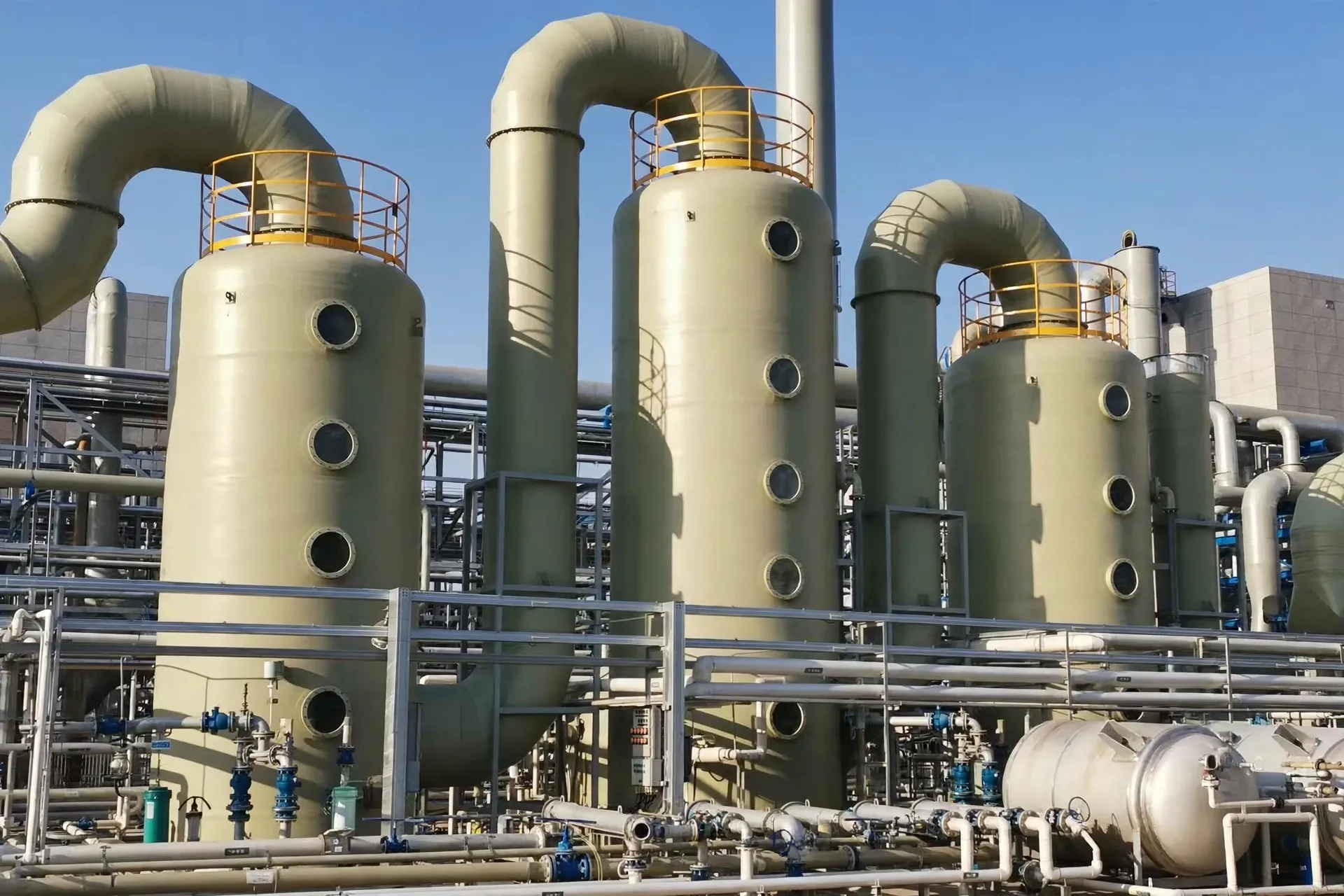
Direct answer: Sizing an FRP scrubber tower starts with four facts — gas flow rate, pollutant and its concentration, required removal efficiency, and operating temperature. Gas flow and empty-tower gas velocity fix the tower diameter; pollutant, concentration and the removal target fix the packing height; packing type and gas velocity fix the pressure drop, which fixes the fan. For a preliminary check, the empty-tower gas velocity should not be higher than 2.3 m/s, and Yashi's vertical scrubber page gives a removal efficiency of about 85–98% under suitable conditions. No supplier can size a tower from flow rate alone — if a quote asks for nothing else, it is not a real design.
Who This Guide Is For
This article is written for EPC contractors and environmental equipment integrators who have to specify a scrubber tower before ordering one, and for distributors who need to check whether a supplier's proposal fits the project. If you are the end user, the same steps tell you exactly which numbers to send the manufacturer so the quote you get back is comparable with other quotes.
What “Sizing” Actually Decides
A scrubber tower is not one size — it is four linked decisions, and getting one wrong breaks the others:
- Tower diameter — fixed by gas flow rate and gas velocity. Too narrow, and the gas moves too fast, carries liquid out of the top and raises pressure drop. Too wide, and the gas moves too slowly, liquid distribution gets uneven and removal drops.
- Packing height — fixed by what must be removed and how completely. A tower that removes 85% of a dilute gas is not the same tower as one that must remove 98% of a concentrated gas.
- Spray levels and liquid flow — fixed by packing height and the chemistry. The scrubbing liquid must wet the whole packing bed, and its pH must be held in range (Yashi's vertical tower page lists online pH monitoring and chemical dosing as system components).
- Fan and pump — fixed by pressure drop and liquid flow. Pressure drop decides the fan; the spray system decides the pump.
Change any one input — flow, concentration, removal target — and at least one of these four changes with it.
Step 1: Start With Gas Flow Rate (m³/h)
Gas flow rate is the one number every sizing starts from, and it must be the actual operating flow, not the fan's nameplate maximum. Ask three questions before using it:
- Is the stated flow the normal flow, the maximum flow, or a future expanded flow? Size for the maximum the tower will actually see, and say so in the inquiry.
- Is the flow steady or does it swing (for example, batch production, or several exhaust branches opening and closing)? A tower sized only for the average will flood at the peak.
- Is the flow given at actual temperature, or converted to standard conditions? Hot gas occupies more volume, so the same mass flow means a larger actual volume — and a larger diameter.
Rule of thumb: if you only know the fan size, do not size from it. Send the process exhaust flow instead, and note the expected variation.
Step 2: Gas Velocity Fixes the Diameter
Once flow is known, diameter follows from the empty-tower gas velocity — the gas speed through the empty tower cross-section. The empty-tower gas velocity should not be higher than 2.3 m/s. The final value is set by the required removal efficiency, tower dimensions, pressure drop and mist carryover limits — 2.3 m/s is the ceiling, not a fixed design value, and the low end of the range depends on keeping the packing evenly wetted.
Diameter is calculated as D = √(4Q / (π × v)), where Q is the gas flow in m³/s and v is the velocity in m/s. The table below applies that formula up to the 2.3 m/s limit, so you can check a supplier's proposed diameter in seconds:
| Gas flow (m³/h) | Diameter at 0.6 m/s | Diameter at 2.3 m/s |
|---|---|---|
| 2,000 | 1.09 m | 0.55 m |
| 5,000 | 1.72 m | 0.88 m |
| 10,000 | 2.43 m | 1.24 m |
| 20,000 | 3.43 m | 1.75 m |
Worked example — 5,000 m³/h: 5,000 m³/h is 1.39 m³/s. At 1.0 m/s, the cross-section needed is 1.39 m², giving a diameter of about 1.33 m. Across the full 0.6–2.3 m/s range, the diameter falls between 0.88 m and 1.72 m. So if a proposal for 5,000 m³/h shows a 0.8 m tower, the gas velocity is about 2.76 m/s — above the 2.3 m/s limit — and mist carryover and pressure drop need a hard question; if it shows a 2.5 m tower, the velocity is only about 0.28 m/s, so ask why it is so low and whether the packing will still be evenly wetted. Either answer may be legitimate for a special case — but it must have a reason, not just a price.
Note that this table sizes the vertical tower. A horizontal tower follows the same gas-velocity logic but spreads the flow over a longer, lower body, which suits high airflow where building height is limited — the choice between vertical and horizontal is a site decision, not a performance ranking.
Step 3: Pollutant and Concentration Fix the Packing Height
Diameter answers “how wide”; packing height answers “how much contact is enough”. It depends on:
- What the gas is. Yashi's vertical tower is designed for water-soluble acidic and alkaline pollutants — HCl, SO₂, H₂S, NH₃ and acid mist — neutralised in the scrubbing liquid (alkaline solution such as NaOH for acidic gases; dilute sulfuric acid for NH₃, which can also allow ammonium sulfate recovery). A gas that dissolves easily needs less contact than one that does not.
- Inlet concentration. Doubling the concentration does not just double the chemical use — it usually needs more packing height to reach the same outlet level.
- Required removal efficiency. Yashi's page states approximately 85–98% may be achievable under suitable operating conditions, with actual performance depending on gas composition, inlet concentration, liquid chemistry, gas velocity and contact design. The jump from 90% to 98% removal is the expensive part of the tower: it is where the extra packing height goes.
- What the tower cannot do. The same page is explicit that a standalone scrubber has limited effectiveness against heavy oil mist and poorly water-soluble, high-molecular-weight VOCs. If those are in the gas, packing height will not fix it — an additional treatment step is needed.
This is why no honest article can print a universal packing-height table: the height is a result of the gas, the concentration and the removal target together. Any table that gives one height per flow rate without asking for concentration is guessing. What you can do instead is send the four facts in the checklist at the end of this article, and compare suppliers on the height, spray levels and liquid flow they propose for the same four facts.
Step 4: Pressure Drop Fixes the Fan — and the Running Cost
Pressure drop is the resistance the gas meets passing through the packing, spray and mist eliminator. It rises with gas velocity and with packing height, which is why the cheapest tower is not always the cheapest system: a tall, narrow tower may cost less to build and more to run every day, because the fan must work harder for the life of the plant.
When comparing proposals, ask for these three numbers together — never one alone:
- Pressure drop of the tower (Pa), at the design flow.
- Fan duty (flow and total pressure), so you can see whether the fan is sized to the tower or just to a catalogue.
- Liquid flow and pump duty, because the recirculation pump is the other continuous energy cost, and its flow must keep the packing fully wetted.
If a supplier cannot give a pressure drop figure for their proposed height, the sizing is not finished yet.
A Short Decision Guide
| Your situation | What to choose / check first |
|---|---|
| Limited floor space, moderate flow | Vertical tower — compact footprint, gas flows upward through the packing |
| Low building height, high airflow | Horizontal tower — check the footprint and the multi-stage spray layout instead |
| Dilute acid or alkaline gas, 85–90% removal is enough | Shorter packing, standard spray levels; confirm the pH control and blowdown plan |
| Concentrated gas, or 95%+ removal required | Taller packing, more spray levels, and a written removal guarantee tied to your stated inlet concentration |
| Gas contains oil mist or poorly soluble VOCs | Do not rely on a scrubber alone — ask what pre-treatment or downstream step is proposed |
| Cold climate | Freeze protection for piping and recirculation equipment (listed as a consideration on Yashi's product page) — confirm it is included, not assumed |
What to Send the Manufacturer: RFQ Checklist
Copy this list into your inquiry. A supplier who receives it can give you a real design; a supplier who does not ask for it is quoting a box, not a system.
- Gas flow rate (m³/h) — normal and maximum, and whether it varies
- Pollutant(s) — for example HCl, SO₂, NH₃, H₂S — and inlet concentration
- Required outlet concentration or removal efficiency (for example ≥95%)
- Gas temperature (normal and maximum)
- What else is in the gas — dust, oil mist, VOCs, humidity
- Installation site — indoors or outdoors, available footprint and height limit, cold-climate freeze protection needed or not
- Required delivery time and site (country/port) — for export packing and freight
- Any standard, inspection or documentation the project requires
If you are selecting a tower for HCl, SO₂ or NH₃, start with Yashi's FRP Vertical Scrubber Tower; for high airflow with limited height, compare it with the FRP Horizontal Scrubber Tower. For resin choice under hot or concentrated chemicals, see also The Right Resin for the Right Job — the resin, not the glass fibre, decides chemical resistance.
Frequently Asked Questions
Can I size a scrubber from flow rate alone?
YAS: No. Flow rate plus gas velocity gives you the diameter, but packing height, spray levels and fan size also need the pollutant, its concentration and the removal target. A quote based on flow alone is a price for a size, not a design for your gas.
What happens if the gas velocity is too high?
YAS: Liquid gets carried out of the top (mist carryover), pressure drop rises, and the fan uses more power. That is why the empty-tower gas velocity is capped at 2.3 m/s rather than “the faster, the better”.
What happens if the gas velocity is too low?
YAS: The tower gets wider than it needs to be, and liquid may not spread evenly over the packing, which can reduce removal even though the tower is bigger. Oversizing is not a safe shortcut.
Does a taller tower always remove more?
YAS: Up to a point, yes — more packing means more gas–liquid contact. But beyond the height needed for your concentration and target, extra height mainly adds pressure drop and cost. The right height is the one calculated for your four facts, not the tallest one offered.
How do I compare two suppliers' proposals?
YAS: Make them quote on the same four facts — flow, pollutant and concentration, removal target, temperature — then compare diameter, packing height, spray levels, pressure drop and fan duty side by side. If one proposal is much cheaper, the difference is usually in one of those five numbers.