
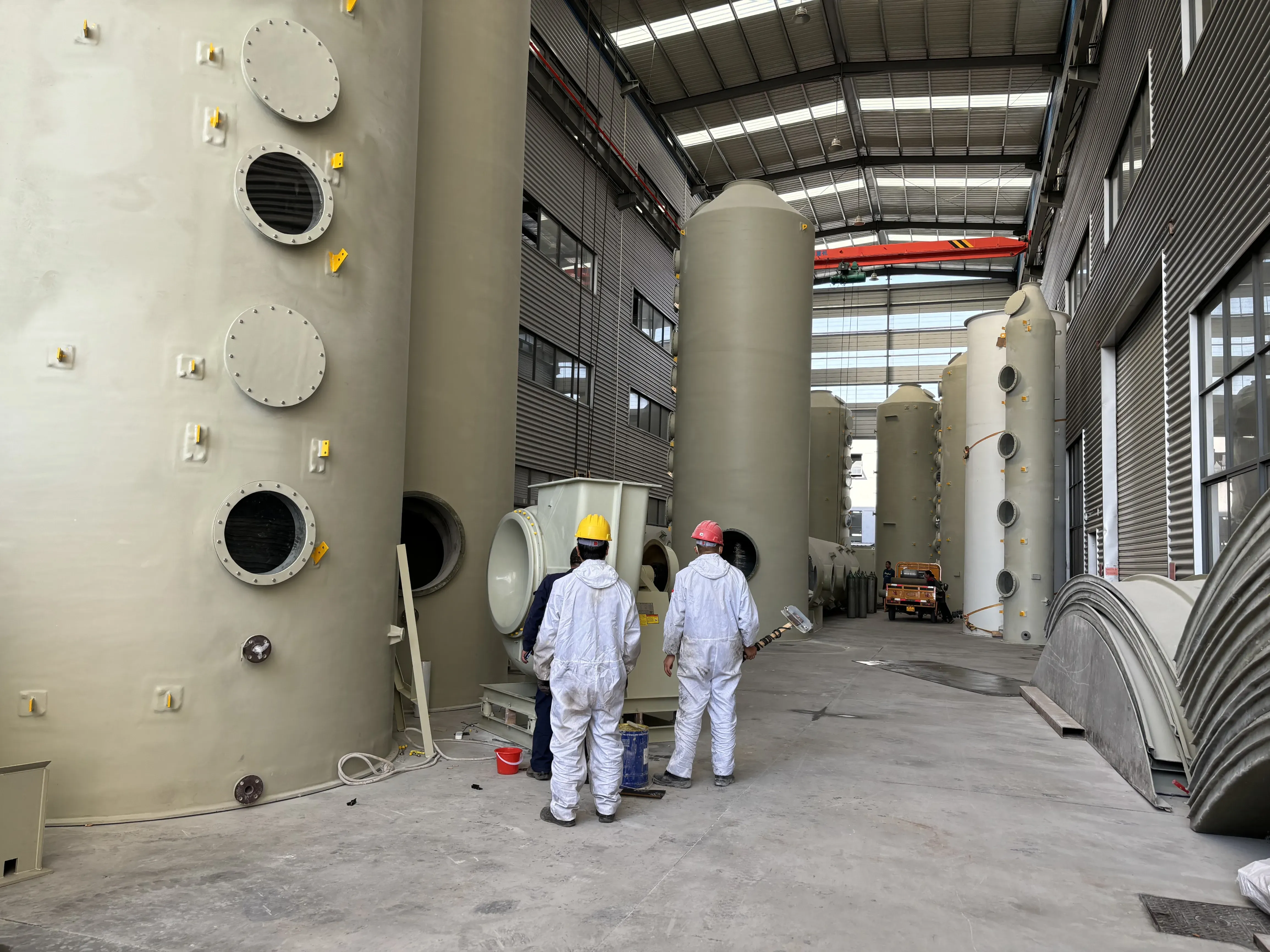
Scrubber Towers
FRP Vertical Scrubber Tower
Built for demanding storage and process applications, YAS FRP tanks offer excellent corrosion resistance, durable construction, and flexible customization for different media and operating conditions.
YAS Can:
- Material
- FRP, anti-static FRP, flame-retardant FRP, SUS304/316, and HDPE.
- Closure
- RAL colors and other international standard colors are available.
- Standards
- GB, ISO, ASTM, and applicable North American standards available.
FRP Vertical Scrubber Tower
Product Overview
An FRP vertical scrubber tower is a core component of wet exhaust gas treatment systems. Using a countercurrent spray scrubbing process, it brings exhaust gas into close contact with scrubbing liquid to absorb and neutralize acidic, alkaline, and water-soluble pollutants.
The tower features a corrosion-resistant FRP housing and a compact vertical cylindrical design that minimizes floor space. It is commonly used for exhaust gas pretreatment and the removal of pollutants such as dust, hydrogen chloride (HCl), hydrogen fluoride (HF), sulfur dioxide (SO₂), and ammonia (NH₃).
FRP vertical scrubber towers can be installed upstream of biological trickling filters and biofilters for pretreatment. They are also suitable for absorbing ammonia-containing exhaust from ammonia stripping towers.
Working Principle
Exhaust gas enters through the inlet at the bottom of the tower and flows upward. A recirculation pump delivers the scrubbing solution to the spray headers at the top, where corrosion-resistant nozzles atomize the liquid downward. The gas and liquid flow in opposite directions, maximizing contact between the two phases.
Water-soluble pollutants and acidic or alkaline compounds transfer into the scrubbing liquid and undergo absorption and chemical neutralization.
- Acidic gases (HCl, SO₂, H₂S): An alkaline solution, such as sodium hydroxide (NaOH), is used for neutralization.
- Alkaline gases (NH₃): Dilute sulfuric acid can be used for absorption and, where the process is properly designed, ammonium sulfate recovery.
- Particulate matter: Dust particles can also be captured by the spray droplets.
The treated gas then passes upward through a mist eliminator to remove entrained liquid droplets before leaving through the outlet at the top of the tower.
The scrubbing liquid, containing absorbed pollutants, collects in the bottom recirculation tank for reuse. Periodic blowdown and chemical replenishment help maintain the required solution concentration and treatment performance.
Applications
- Treatment of acidic and alkaline exhaust gases in chemical, fine chemical, and pharmaceutical facilities
- Acidic and alkaline exhaust gas treatment in electroplating and surface treatment operations
- Pretreatment of ammonia- and hydrogen sulfide-containing exhaust at landfill leachate treatment facilities and wastewater treatment plants
- Absorption of ammonia-containing exhaust from ammonia stripping towers, with potential ammonium sulfate recovery
- Acid mist treatment in metal smelting and pickling operations
- Acidic and alkaline exhaust gas treatment in printing, coating, and laboratory facilities
- Treatment of acidic, alkaline, and water-soluble odorous gases in hazardous waste treatment facilities
- Acidic exhaust gas treatment in electronics and photovoltaic manufacturing facilities
Key Advantages of FRP Vertical Scrubber Towers
1. Corrosion-Resistant FRP Construction
The FRP housing offers excellent resistance to acids and alkalis, along with good weathering and sealing performance when properly designed for the operating conditions. It is suitable for a wide range of corrosive exhaust gas applications.
2. Compact Vertical Design
The cylindrical vertical configuration minimizes the footprint and allows installation both indoors and outdoors, making it suitable for facilities with limited floor space.
3. Effective Pollutant Removal
The tower is designed for efficient absorption and neutralization of water-soluble acidic and alkaline pollutants. Removal efficiencies of approximately 85–98% may be achievable under suitable operating conditions. Actual performance depends on gas composition, inlet concentration, liquid chemistry, gas velocity, and contact design.
4. Easy Operation and Maintenance
The system features a relatively simple structure and can be equipped with maintenance manways for convenient inspection and servicing of packing and spray nozzles. Basic automatic controls can also be incorporated.
5. Lightweight Construction
The tower can be manufactured in modular or sectional FRP construction, helping reduce foundation loads and simplifying transportation, lifting, and on-site installation.
6. Customized Manufacturing
Tower diameter, packing stages, spray levels, and nozzle configurations can be customized according to exhaust gas flow rate, pollutant concentration, and project requirements.
Operating Conditions and Selection Guide
Recommended Applications
- Water-soluble acidic and alkaline exhaust gases
- Acid mist, ammonia, hydrogen sulfide, and particulate-laden exhaust streams
- Wet absorption and neutralization, particularly as pretreatment upstream of biological odor control systems
Typical Empty-Tower Gas Velocity
A preliminary design range of approximately 0.6–1.2 m/s may be considered. The final design should be determined according to the required removal efficiency, tower dimensions, pressure drop, and mist carryover limits.
Process Role
Wet scrubbing and chemical neutralization are suitable for many acidic and alkaline exhaust streams, including applications requiring upstream protection for biological treatment equipment.
Important Considerations
- Limited removal of certain pollutants: A standalone scrubber may have limited effectiveness against heavy oil mist and poorly water-soluble, high-molecular-weight VOCs. Additional treatment processes may be required.
- Scrubbing liquid management: Monitor the recirculating liquid pH regularly and replenish chemicals as needed. Spent scrubbing liquid should be sent to an appropriate wastewater treatment system.
- Cold-weather operation: Provide suitable freeze protection for piping and recirculation equipment in low-temperature environments.
- Performance verification: Removal efficiency should be confirmed through process design calculations and, where required, performance testing under specified operating conditions.
System Components
- FRP vertical tower housing
- Gas inlet section
- Gas distribution system
- Packing bed
- Spray piping and corrosion-resistant nozzles
- Mist eliminator
- Bottom recirculation tank
- Recirculation pump
- Chemical dosing system
- Online pH monitoring system
- Maintenance manways
- Gas outlet
- Blowdown and overflow piping
- Induced-draft fan