
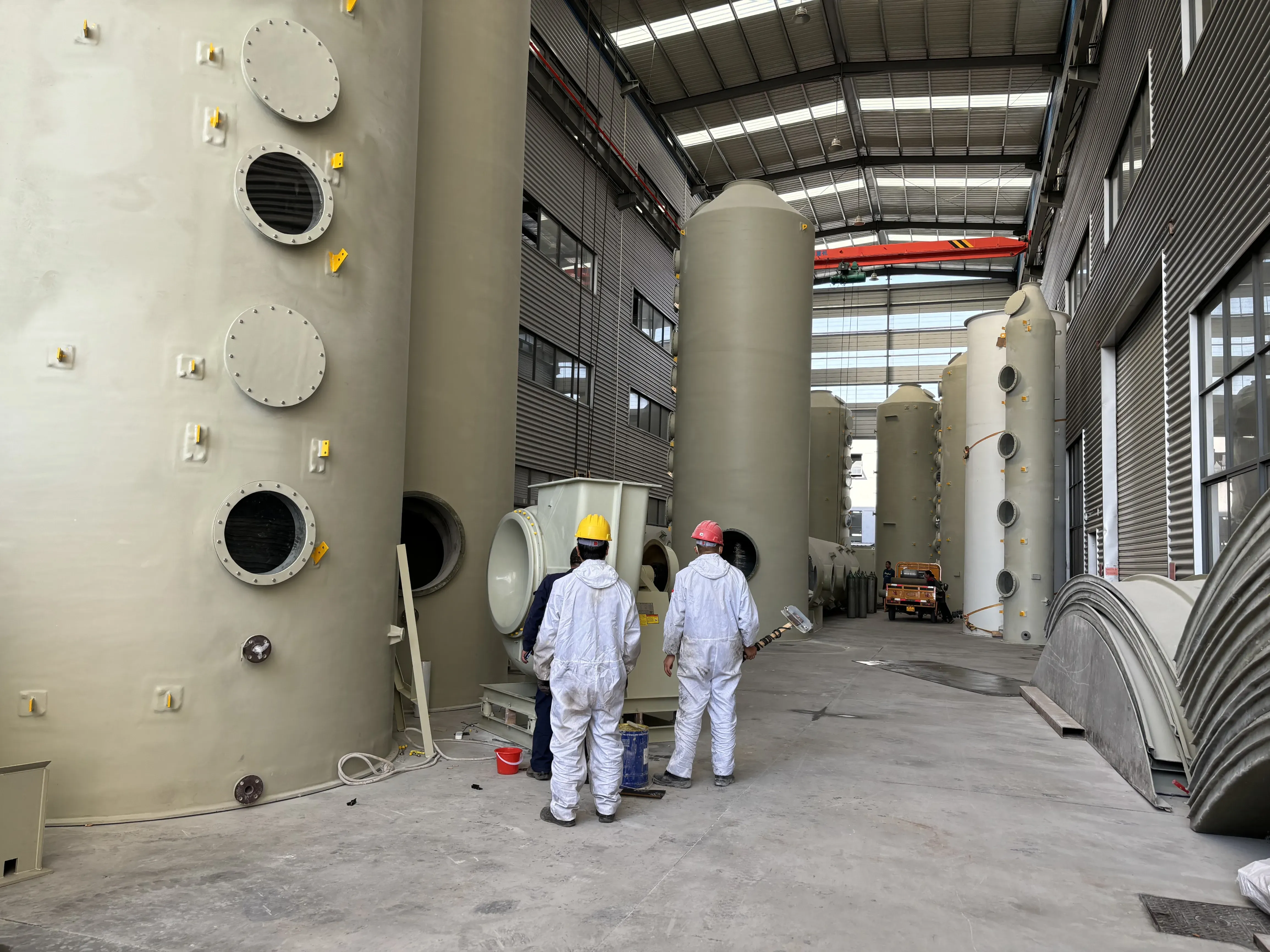
Scrubber Towers
FRP Horizontal Scrubber Tower
Built for demanding storage and process applications, YAS FRP tanks offer excellent corrosion resistance, durable construction, and flexible customization for different media and operating conditions.
YAS Can:
- Material
- FRP, anti-static FRP, flame-retardant FRP, SUS304/316, and HDPE.
- Closure
- RAL colors and other international standard colors are available.
- Standards
- GB, ISO, ASTM, and applicable North American standards available.
FRP Horizontal Scrubber Tower
Product Overview
An FRP horizontal scrubber tower is a wet scrubbing system designed for industrial exhaust gas treatment. Unlike conventional vertical cylindrical scrubbers, it features a horizontal gas-liquid contact design. Its FRP housing provides excellent corrosion resistance, making it suitable for acidic and alkaline exhaust gas applications.
The low-profile design is ideal for facilities with limited overhead clearance where a tall vertical tower cannot be installed. By bringing exhaust gas into close contact with scrubbing liquid, the system helps remove water-soluble acidic and alkaline pollutants, ammonia, hydrogen sulfide, acid mist, and particulate matter.
It is commonly used for exhaust gas pretreatment, including the removal of dust and soluble contaminants upstream of biological odor control systems. It can also be used to treat ammonia-containing exhaust from ammonia stripping towers.
Working Principle
Exhaust gas enters through the inlet at one end of the tower and flows horizontally through the housing. A recirculation pump delivers scrubbing liquid to multiple spray headers, where nozzles atomize the liquid downward or at an angle. The gas passes horizontally through the spray zones, allowing thorough contact between the gas and liquid.
Water-soluble pollutants are captured by the droplets and removed through absorption and chemical neutralization.
- Acidic gases (HCl, SO₂, H₂S): Alkaline scrubbing solutions can be used for neutralization, subject to the gas composition and process requirements.
- Alkaline gases (NH₃): Dilute sulfuric acid can be used for absorption, with potential recovery as an ammonium salt solution where the process is appropriately designed.
- Particulate matter: Dust and other particles can be captured by the spray droplets and removed with the circulating liquid.
The gas then passes through a multistage mist elimination section to remove entrained liquid droplets before leaving through the outlet.
The spent scrubbing liquid collects in the bottom recirculation tank and is reused. Online pH monitoring helps maintain the required solution conditions. Chemicals are replenished as needed, while blowdown is discharged to the appropriate wastewater treatment system.
Applications
- Treatment of acidic, alkaline, and malodorous exhaust gases in chemical, fine chemical, and pharmaceutical facilities
- Acid mist removal in electroplating and surface treatment operations, especially where building height is limited
- Pretreatment of ammonia- and hydrogen sulfide-containing exhaust at landfill leachate treatment facilities and wastewater treatment plants
- Absorption of ammonia-containing exhaust from ammonia stripping towers
- Treatment of acid mist and dust-laden exhaust in metal smelting and pickling operations
- Treatment of water-soluble acidic and alkaline gases and odors in hazardous waste treatment facilities
- Exhaust gas treatment upgrades in printing, coating, and laboratory facilities with limited installation height
- High-volume exhaust gas treatment applications where a horizontal flow path and low-profile equipment arrangement are preferred
Key Advantages of FRP Horizontal Scrubber Towers
1. Corrosion-Resistant FRP Construction
The FRP housing offers resistance to acids and alkalis, with good weathering and sealing performance when properly designed for the operating conditions. It is suitable for a wide range of corrosive exhaust gas applications.
2. Ideal for Height-Restricted Facilities
The low-profile horizontal design is well suited to facilities with limited ceiling height or rooftop clearance, reducing the need for a tall vertical installation.
3. Suitable for High Airflow Applications
The horizontal flow path can be designed for relatively low pressure drop, depending on the tower dimensions, spray configuration, packing, and mist eliminator design. This can help reduce fan energy consumption in high-volume exhaust systems.
4. Convenient Inspection and Maintenance
Side access manways allow convenient inspection of internal components. Spray headers, nozzles, and optional packing sections can be designed for easier maintenance and replacement.
5. Multistage Scrubbing Options
Multiple spray zones can be incorporated into a single unit to provide staged absorption and neutralization, helping improve treatment performance when properly designed for the target pollutants.
6. Customized Manufacturing
Tower length, spray stages, mist elimination sections, and internal configurations can be customized according to exhaust gas flow rate, pollutant concentration, and site layout.
Operating Conditions and Selection Guide
Recommended Applications
- Water-soluble acidic and alkaline gases
- Ammonia, hydrogen sulfide, acid mist, and suitable particulate-laden exhaust streams
- High-volume exhaust gas applications in facilities with limited overhead clearance
**Typical Gas Velocity