
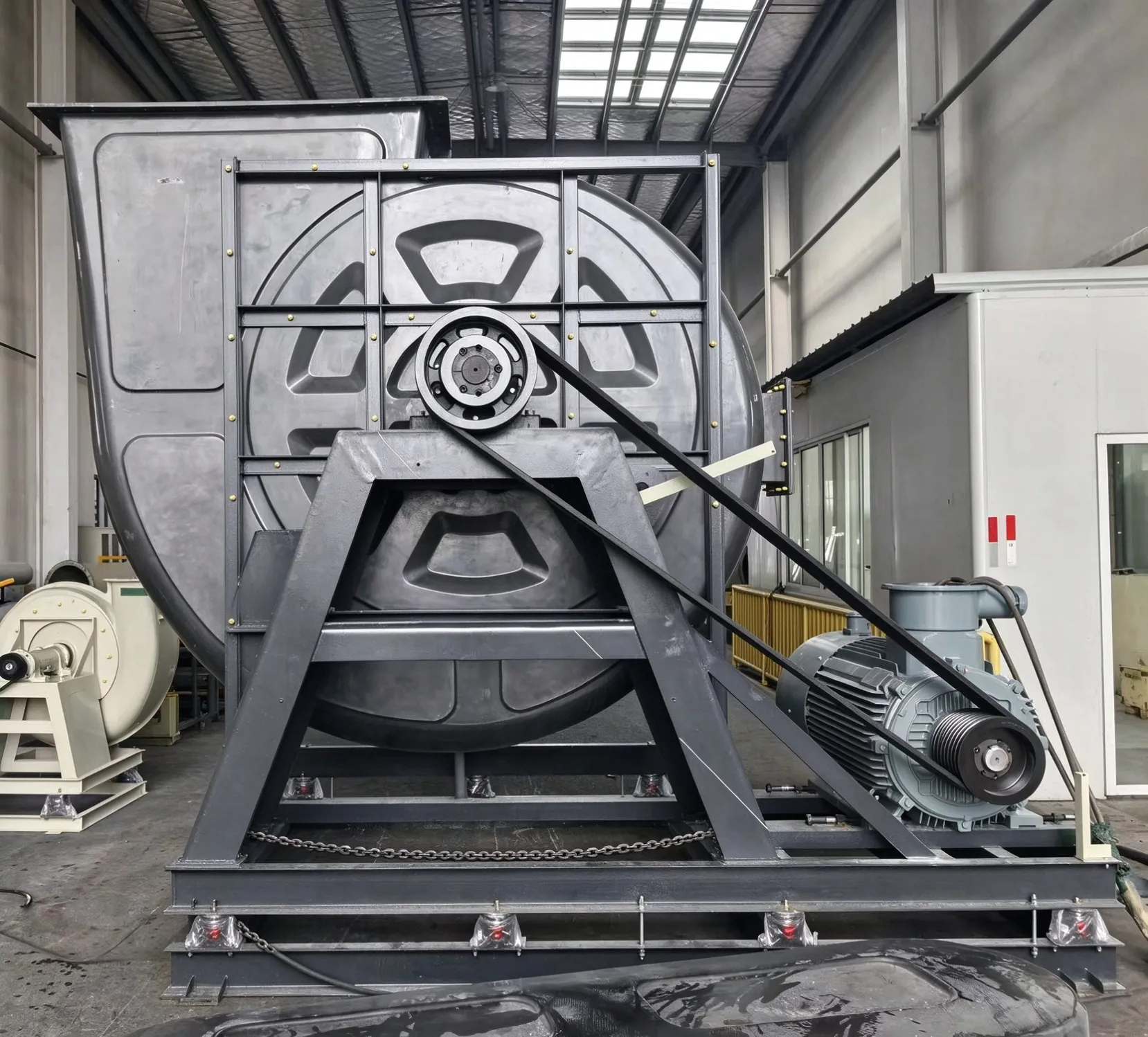
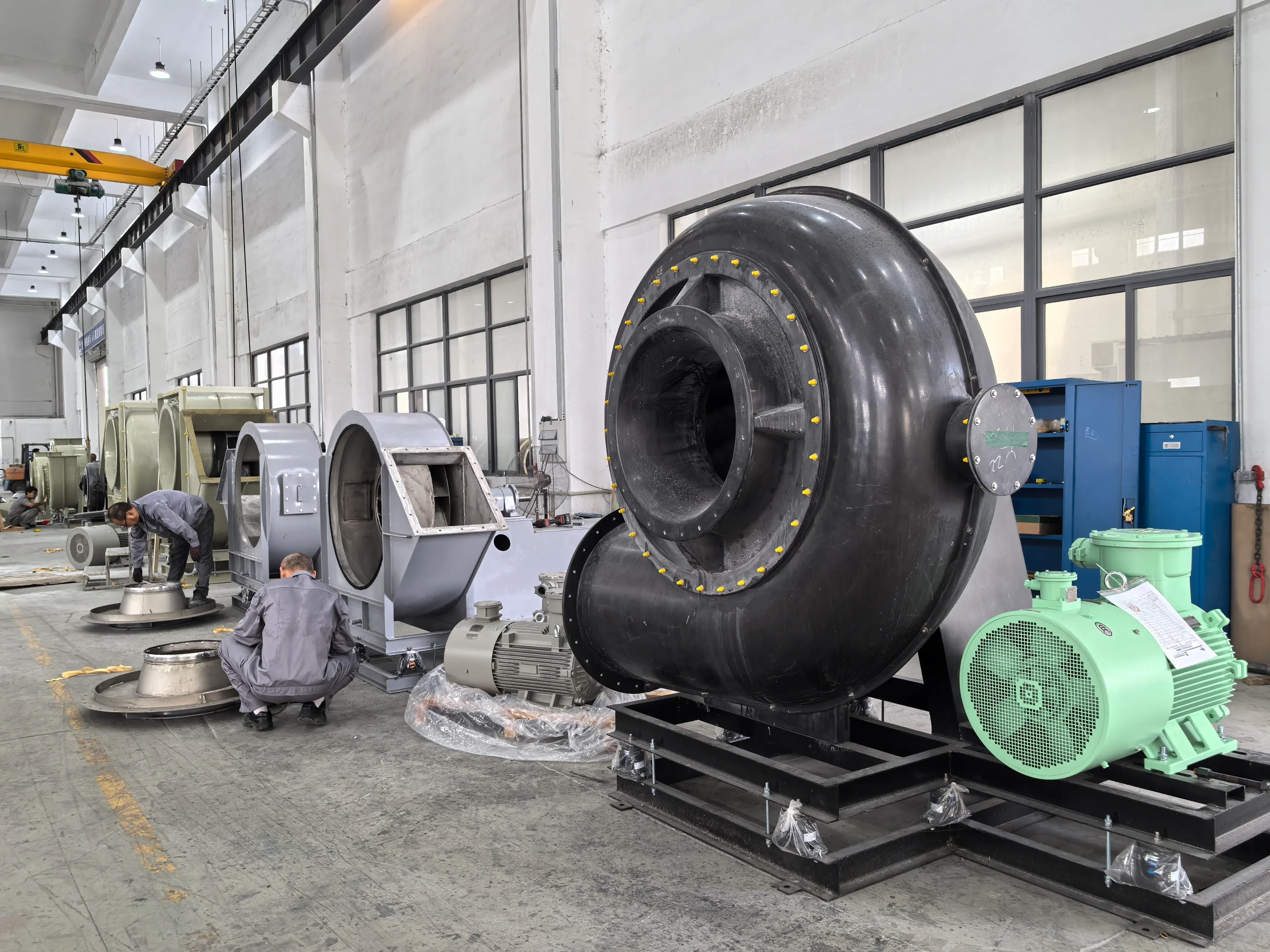
FRP Fan
FRP explosion proof fan
Our FRP fans are engineered for exhaust, ventilation, and gas treatment systems where conventional materials may face corrosion challenges.
YAS Can:
- Material
- FRP, anti-static FRP, flame-retardant FRP, SUS304/316, and HDPE.
- Color
- RAL colors and other international standard colors are available.
- Standards
- GB, ISO, ASTM, and applicable North American standards available.
FRP Centrifugal Fans
Flame-Retardant · Explosion-Proof Options · Integrated Impeller · Zero-Leakage Shaft Sealing · Custom Material Solutions
The Power Behind Corrosive Exhaust Gas Treatment Systems
1. Product Overview
Manufactured using vinyl ester or epoxy resin reinforced with fibers, our FRP centrifugal fans feature a density approximately one-quarter that of steel, high specific strength, and smooth interior surfaces that resist scale buildup. They can be designed for demanding corrosive environments across a pH range of 1–14, subject to media compatibility and operating conditions.
With no welded seams or metal components in contact with the process stream, the design helps eliminate electrochemical corrosion. The impeller and housing are integrally molded. When equipped with a suitable explosion-proof motor, the fan can handle industrial exhaust containing corrosive, flammable, or explosive substances, making it suitable for use with spray scrubbers, activated carbon adsorption systems, UV photolysis units, biological deodorization systems, and other exhaust treatment equipment.
More importantly, we do not rely on a one-material-fits-all approach. Resin systems, reinforcing fibers, liner structures, and shaft sealing arrangements can all be customized according to the process media. For challenging applications involving hydrofluoric acid (HF), chromic acid, and organic solvents, we offer application-specific material solutions based on actual operating conditions.
2. Key Advantages
Custom Solutions for Specialized Media
Resin systems, reinforcing fibers, and liner structures are selected according to the specific media, including hydrofluoric acid, chromic acid, and organic solvents. We develop tailored solutions for applications that standard fan designs may not be able to handle.
Flame-Retardant Materials
Flame-retardant resin systems can achieve an oxygen index of ≥30, with self-extinguishing properties after removal of the ignition source and no molten dripping under the specified test conditions. Suitable configurations can be selected to meet applicable fire safety requirements for chemical plants and cleanroom facilities.
Explosion-Proof Design
FRP components do not generate mechanical sparks through impeller-to-housing contact under normal design conditions. When configured with a suitable explosion-proof motor and terminal box, including options rated Ex d IIB T4, the fan can be designed for specified flammable and potentially explosive exhaust applications.
Integrally Molded Impeller
The impeller is integrally molded without welded seams, assembled joints, or exposed metal. Dynamic balancing can achieve a balance quality better than G6.3. This design helps reduce corrosion-related imbalance, joint failure, vibration, and maintenance requirements.
Zero-Leakage Shaft Sealing
A double mechanical seal combined with a positive-pressure barrier gas system is available to minimize exhaust leakage and prevent process gases from entering the bearing housing, helping protect bearings from corrosive media.
No Metal in Contact with Process Media
The all-FRP wetted construction helps eliminate electrochemical corrosion associated with dissimilar metals. With appropriate material selection, the fan can be adapted to different process media without necessarily replacing the entire unit.
High-Pressure Capability
Total pressure can reach up to 8,000 Pa, making the fan suitable for high-resistance systems involving tall towers, long duct runs, or multiple stages in series.
Smooth Surfaces for Easier Cleaning
Smooth interior surfaces help reduce the accumulation of salts, dust, and deposits, potentially extending maintenance intervals and reducing maintenance costs.
Lightweight Construction for Easier Installation
With a density approximately one-quarter that of steel, FRP construction reduces loads on supporting structures and simplifies lifting and installation. It can also help minimize the need for structural reinforcement during plant retrofits.
3. Custom Material Solutions for Specialized Media
Hydrofluoric acid, chromic acid, and organic solvents present particular challenges for conventional FRP fans. Each can affect resin systems or reinforcing materials in different ways, so material selection must be tailored to the specific application.
Process Media | Why Standard FRP May Be Unsuitable | Our Custom Solution |
|---|---|---|
Hydrofluoric Acid (HF) | HF attacks the silica in conventional glass fibers. Damage to the glass-fiber reinforcement can rapidly reduce structural strength. | We select the resin, reinforcement, liner, and shaft seal as an integrated system based on the actual media composition, concentration, and temperature. Coupon immersion testing can be conducted before production when necessary. |
Chromic Acid (including CrO₃ and other hexavalent chromium compounds) | Strong oxidizing conditions can attack ester bonds in conventional unsaturated polyester resins, potentially causing degradation, blistering, and delamination. | We develop an application-specific combination of resin, reinforcement, liner, and shaft seal based on the actual process conditions. Testing can be conducted before production when required. |
Organic Compounds and Solvents | Solvents can cause resin swelling and permeation. Prolonged exposure may soften conventional resins and reduce their strength. Ketones, esters, and aromatic hydrocarbons can be particularly challenging. | We customize the resin, reinforcement, liner, and shaft seal according to the media composition, concentration, and temperature, with preliminary immersion testing available when necessary. |
Mixed Process Conditions | Actual exhaust streams may contain mixed acids and alkalis, fluorides and chlorides, dust, crystallized salts, or temperatures approaching the design limit. | We evaluate the combined operating conditions and develop a suitable material and sealing configuration for the application. |
Our Customization Process
Provide the process media composition and concentration → Receive our material selection proposal → Conduct optional coupon or immersion testing → Finalize the design and proceed with production.
Share your process conditions with us, and our team will help determine an appropriate fan material configuration for your application.
4. Material Properties
4.1 Flame-Retardant Performance
Flame-retardant unsaturated polyester or vinyl ester resins can be used with halogen-free flame-retardant systems. Selected formulations can achieve an oxygen index of ≥30 and provide self-extinguishing behavior after removal of the ignition source, without molten dripping and with low smoke density.
The final configuration should be evaluated against the applicable fire safety requirements for chemical plants, pharmaceutical facilities, electronics cleanrooms, and underground spaces.
4.2 Explosion-Proof Applications
FRP is a nonmetallic material, reducing the risk of mechanical sparks from impeller-to-housing contact compared with conventional metal designs.
The fan can incorporate antistatic measures, such as conductive resin or conductive coatings, controlled surface resistance, and reliable grounding. When equipped with a suitable explosion-proof motor and terminal box, including optional Ex d IIB T4 configurations, it can be designed for specified applications involving paint spraying, solvent recovery, and exhaust containing organic solvents.
Final suitability depends on the hazardous-area classification and the applicable local requirements.
4.3 Integrally Molded Impeller
The impeller is formed as an integrated component using a dedicated mold and is encapsulated and cured with the main shaft. The design eliminates welded seams, bolted joints, and exposed metal.
After dynamic balancing, the impeller can achieve a balance quality better than G6.3, helping reduce vibration and noise. The integrated construction also helps avoid imbalance caused by metal corrosion and cracking associated with weld deterioration in acidic environments.
4.4 Additional Material Characteristics
Property | Description |
|---|---|
Corrosion Resistance | Designed to resist acids, alkalis, salt spray, and selected organic solvents. Resin systems may include vinyl ester, epoxy, phenolic epoxy, or other specialized resins, depending on the media. |
Lightweight and High Strength | Density of approximately 1.8–2.1 g/cm³, around one-quarter that of steel, with high specific strength. |
Integrated Construction | No welded seams or metal components in contact with the process media, helping prevent electrochemical corrosion and weld-related leakage. |
Electrical and Thermal Insulation | High volume resistivity and low thermal conductivity. The FRP housing is electrically nonconductive unless a conductive formulation is specified. |
Aging Resistance | UV stabilizers and anti-aging additives can be incorporated to help reduce outdoor weathering, surface degradation, and cracking. |
Maximum Operating Temperature | Up to 80°C under specified conditions. Applications above this limit require a separate engineering review. |
5. Performance Specifications
Parameter | Typical Range or Configuration |
|---|---|
Airflow | 1,000–100,000 m³/h |
Total Pressure | 500–8,000 Pa; high-pressure configurations are available for systems with high tower resistance or long duct runs. |
Motor Power | 0.75–200 kW |
Total Pressure Efficiency | ≥80% |
Noise Level | ≤85 dB(A) |
Operating Temperature | ≤80°C |
Flame-Retardant Performance | Oxygen index ≥26; self-extinguishing after removal of the ignition source. |
Explosion-Proof Configuration | Optional Ex d IIB T4, with a suitable explosion-proof motor and terminal box. |
Impeller Design | Integrally molded impeller; dynamic balance quality better than G6.3. |
Specialized Media | Custom resin, reinforcement, and liner solutions for hydrofluoric acid, chromic acid, organic solvents, and other specified media. |
Drive Options | Direct drive, belt drive, or shaft drive, subject to the selected configuration. |
Discharge Orientation | 0°, 90°, 180°, or 270° options to accommodate site ductwork layouts. |
6. Shaft Sealing System: A Zero-Leakage Solution for FRP Fans
Zero-Leakage Shaft Sealing Options
Design Feature | Technical Solution |
|---|---|
Seal Assembly | Double cartridge mechanical seals with hard, wear-resistant materials such as silicon carbide or tungsten carbide for the rotating and stationary faces. |
Positive-Pressure Barrier Gas | Clean air or nitrogen is supplied to the seal chamber to create a positive-pressure barrier, helping prevent process gas from escaping or entering the bearing housing. |
Corrosion-Resistant Materials | Shaft sleeves can be made from 316L stainless steel, titanium, or PTFE-coated materials. Seals may use fluororubber or PTFE encapsulation. For fluoride-containing media, tungsten carbide/PTFE seal combinations may be considered, avoiding silicon-containing components where required. |
Axial Isolation | The bearing housing is physically isolated from the process gas chamber. Flushing or purge connections can help prevent crystallized salts from accumulating and reduce uneven seal wear. |
Shaft System Rigidity | Shaft deflection and seal-face runout are controlled to help maintain seal-face alignment during long-term operation, in combination with the seamless FRP housing design. |
Optional Configuration | For low-flow applications involving highly toxic or high-value media, a fully enclosed, sealless magnetic-drive design may be considered. |
7. Applications and Industries
YAS FRP centrifugal fans are suitable for exhaust handling and ventilation applications in a wide range of industries, including:
- Chemical processing and electroplating
- Semiconductor and PCB manufacturing
- Pharmaceutical production
- Battery manufacturing
- Metal pickling and phosphating
- Paper manufacturing and food processing
- Laboratory ventilation
- Odor control at wastewater treatment plants
- Odor control at waste transfer stations and landfills
- Paint-spray exhaust treatment
- Solvent recovery systems
- Flue gas desulfurization and denitrification
For specialized exhaust streams containing hydrofluoric acid, chromic acid, or organic solvents, application-specific material solutions can be developed according to the actual process conditions.
Important Notes
The standard maximum operating temperature is 80°C, and total pressure can reach up to 8,000 Pa, depending on the selected configuration.
For applications involving hydrofluoric acid, chromic acid, organic solvents, or other specialized media, please provide the media composition, concentration, and operating temperature. We will use this information to evaluate the resin system, reinforcing fibers, liner structure, and shaft sealing arrangement. Coupon immersion testing can be arranged when necessary.
Explosion-proof and flame-retardant configurations can also be selected according to the requirements of the installation site.