
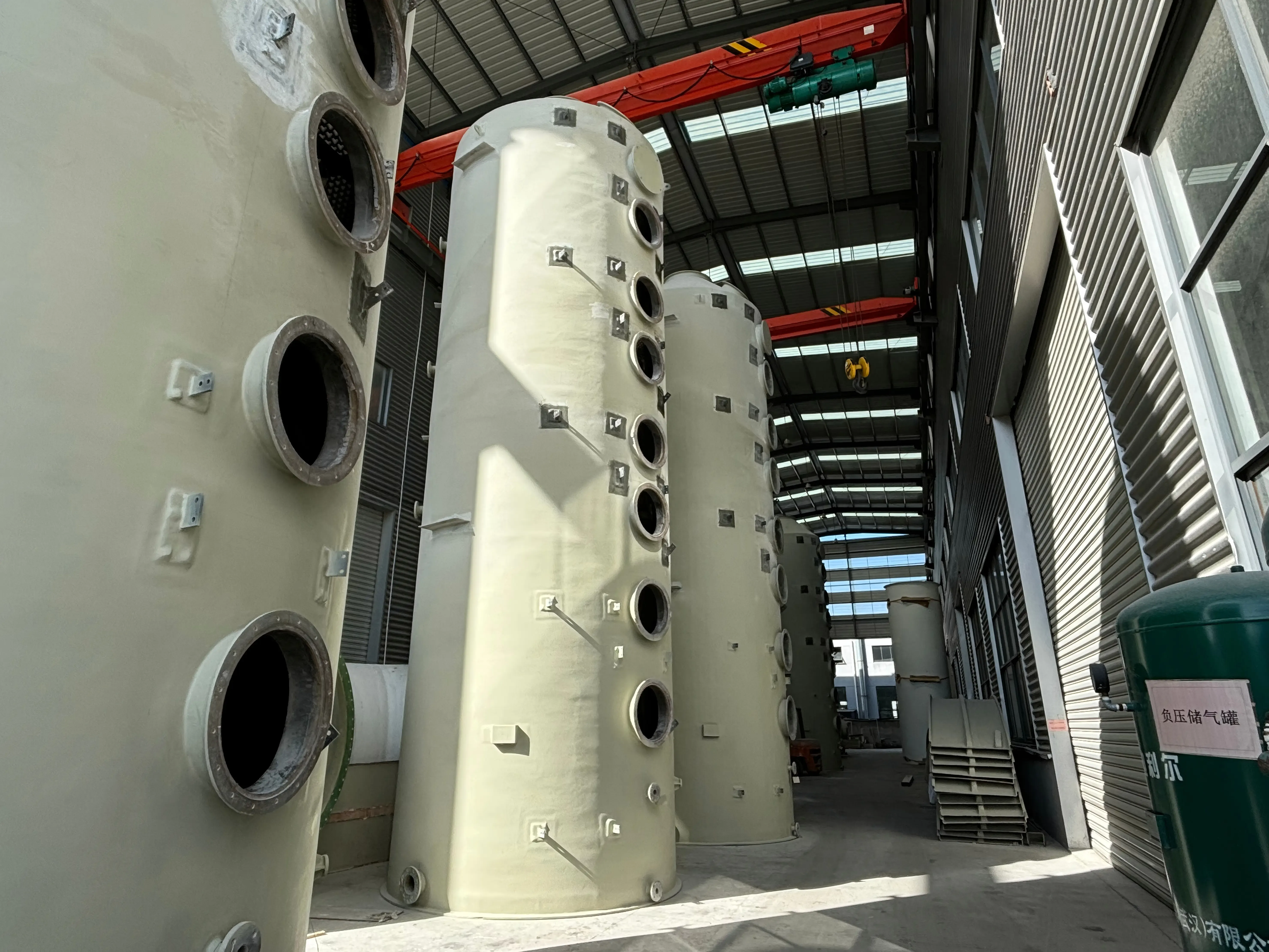
Stripping Towers
FRP Ammonia Stripping Tower
Built for demanding storage and process applications, YAS FRP tanks offer excellent corrosion resistance, durable construction, and flexible customization for different media and operating conditions.
YAS Can:
- Material
- FRP, anti-static FRP, flame-retardant FRP, SUS304/316, and HDPE.
- Closure
- RAL colors and other international standard colors are available.
- Standards
- GB, ISO, ASTM, and applicable North American standards available.
FRP Ammonia Stripping Tower
Product Overview
The FRP Ammonia Stripping Tower is a key pretreatment unit for wastewater with high ammonia nitrogen concentrations. It uses a physical-chemical stripping process to reduce the ammonia nitrogen load and help protect downstream biological treatment systems from excessive loading.
Manufactured from fiber-reinforced plastic (FRP), the tower offers corrosion resistance in alkaline operating conditions. With a proven countercurrent packed-tower design, it provides a practical solution for industrial wastewater pretreatment.
Working Principle
Ammonia nitrogen in wastewater exists in a dynamic equilibrium between ammonium ions (NH₄⁺) and free ammonia (NH₃).
- pH Adjustment: Alkali is added to raise the wastewater pH, typically to 10.5–11.5, converting more ammonium ions into volatile free ammonia.
- Water Distribution: Wastewater is evenly distributed from the top of the tower and flows downward through the packing bed.
- Countercurrent Air Stripping: A fan supplies air from the bottom, flowing upward against the descending wastewater. The large gas-liquid contact area provided by the packing, such as Pall rings or cascade rings, promotes the transfer of free ammonia from the water into the air.
- Off-Gas Treatment: Treated wastewater exits the bottom of the tower and proceeds to downstream treatment. Ammonia-containing off-gas is directed to an acid scrubber, where dilute sulfuric acid can absorb ammonia and produce ammonium sulfate for potential recovery. The treated off-gas is then discharged in accordance with applicable requirements.
Applications
- Landfill leachate with high ammonia nitrogen concentrations
- Fine chemical, coal chemical, fertilizer, and pharmaceutical intermediate wastewater
- Wastewater from large-scale livestock and poultry operations, including biogas slurry
- Ammonia-containing wastewater from electroplating and surface treatment
- High-ammonia wastewater from slaughterhouses and food processing plants
- Leach solutions from non-ferrous metal and rare-earth hydrometallurgical processes
- Sludge dewatering filtrate and municipal sludge digestion supernatant
- Pretreatment of high-ammonia liquid waste from hazardous waste treatment facilities
Key Advantages
Corrosion-Resistant FRP Construction
Designed for alkaline wastewater service, with resistance to corrosion and rust-free construction when properly specified and installed.
Lightweight Construction
The integrated FRP structure simplifies transportation and installation while reducing foundation loading.
Compact Packed-Tower Design
Countercurrent gas-liquid contact promotes ammonia transfer. Ammonia nitrogen removal of approximately 70–90% may be achievable under suitable operating conditions.
Controllable Operation
The system can integrate alkali dosing, liquid distribution, air supply, and off-gas absorption, with automation options available to suit project requirements.
Potential Ammonia Recovery
Ammonia can be absorbed using dilute sulfuric acid to produce ammonium sulfate, enabling potential by-product recovery and helping reduce secondary emissions.
Customized Design
Tower diameter, height, packing type, and system configuration can be tailored to wastewater flow rate, influent ammonia nitrogen concentration, and site conditions.
Operating Conditions and Selection Guide
- Typical influent ammonia nitrogen range: 200–3,000 mg/L for preliminary design consideration.
- Process role: Pretreatment to reduce the ammonia nitrogen load; it does not replace downstream biological treatment.
- Scaling risk: Wastewater with high hardness may cause scale formation and packing blockage. Pretreatment or cleaning provisions may be required.
- Low-temperature operation: Ammonia stripping efficiency may decrease at lower temperatures. Heating or increased airflow may be considered during system design.
- pH control: Alkali dosing is required to raise the pH to the target operating range.
- Off-gas treatment: An appropriately designed acid scrubber is recommended to capture stripped ammonia and control emissions.
Actual removal efficiency depends on influent characteristics, pH, temperature, airflow, liquid flow rate, packing height, and gas-liquid contact time. Final design parameters should be confirmed through process evaluation.
System Components
- FRP ammonia stripping tower
- Spray and water distribution system
- Packing bed
- Mist eliminator
- Air supply fan
- Alkali dosing system
- FRP acid scrubber
- Chemical recirculation tank
- Piping, valves, and fittings